The keeper of the groundsheet
Part of the series Playgroup Productivity
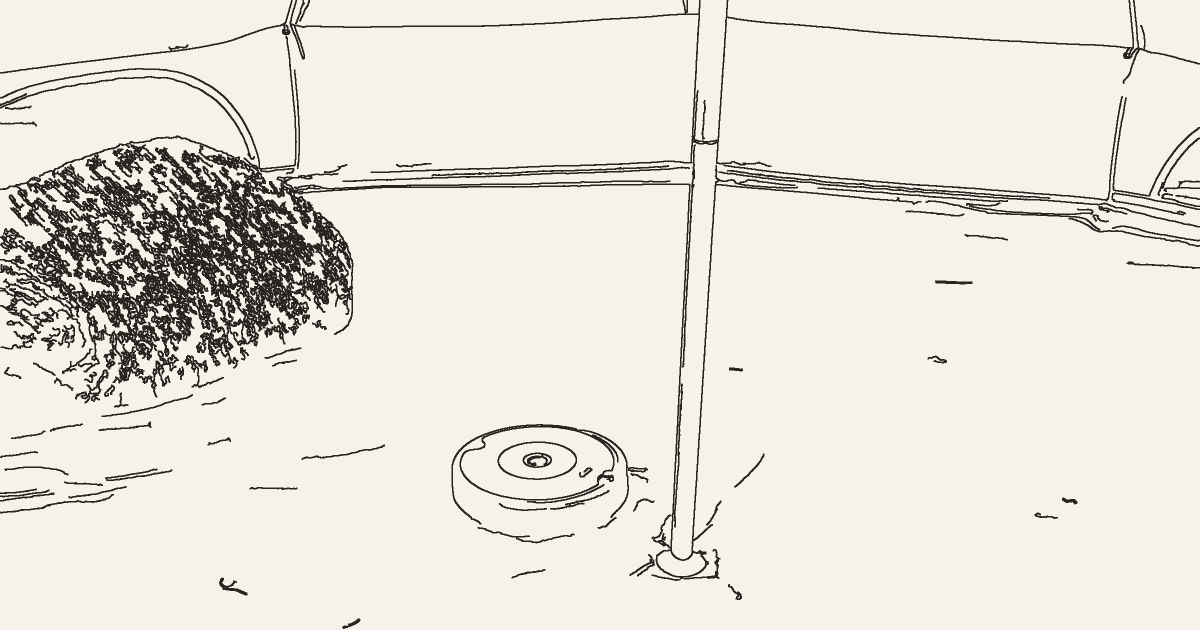
Written 23 September 2026; posted here 2 October, in a month of one small thing a day.
Part of the playgroup productivity series, alongside Vehicles of Productivity, which maps Braitenberg’s fourteen vehicles onto the history of productivity tools.
Nobody told the Roomba it was in a tent.
It had been set down on the groundsheet, its button pressed once, and then the flap had fallen shut and the voices had gone off towards the fire. It began, as it always began, with a spiral: tight at first, then wider, the brushes whirring at a single blade of grass that had come in on somebody’s boot.
Then it met the pole.
The pole did not move. The Roomba touched it with its bumper, stopped, turned through an angle it chose without reason, and set off again. Eleven seconds later it met the pole from the other side. It did not recognise it. It had no word for pole, and no place to keep a word if it had one. Each meeting was the first meeting.
The walls were strange too. In the house the walls had been straight, and it had learned nothing from them, but they had at least allowed a certain rhythm: follow, corner, follow. Here the wall curved away for ever. The Roomba followed it faithfully, its side brush flicking at the seam, and came back to where it started without noticing that it had. A bell tent is a circle, and a circle is a corridor that never ends.
There was a blanket, folded, mustard-coloured, soft enough that the bumper barely registered it. The Roomba pressed against it for a while, uncertain, the way a moth is uncertain about a curtain.
It did not mind any of this. Minding requires a before and an after, and the Roomba lived in a continuous now of bump, turn, go. Outside, somebody laughed. Inside, a leaf crackled into the bin. The battery ticked down one percent at a time, and the machine did the only thing it had ever been asked to do, which was the only thing it knew how to do, which was the thing it was doing.
If you had asked it whether it was productive, it would have answered with a small rising chirp, because that is the sound it makes when you lift it up.
At some point, the dock being twenty miles away in a kitchen in Dorset, the battery reached its floor. The Roomba played the short descending phrase it keeps for this occasion — four notes, a sort of shrug — and stopped, facing the pole, as though it had finally decided to have a proper look.
The groundsheet was noticeably cleaner in a rough circle around the middle, and noticeably not cleaner behind the blanket, which it had never learned to go round. Its whole account of the day was written in dust, for anyone who cared to read it.
Coda: how far is the Roomba from Hermes?
Hermes, the god, is the one who crosses thresholds. He carries messages between Olympus and earth, guides the dead across the Styx, steals Apollo’s cattle and then talks his way out of it. His whole nature is between: he is the boundary that moves. Hermes Agent, the open-source personal agent from Nous Research, borrows the name honestly — it lives on a server, talks to you through whatever you are holding, remembers you across sessions, and writes itself new skills from what worked.
The Roomba is his opposite in almost every respect.
- Memory. The Roomba has none worth the name; every pole is a new pole. Hermes is built around memory — of you, your projects, and its own solutions.
- Messages. The Roomba’s entire vocabulary is a handful of tones and an error code. Hermes is message: its native medium is conversation, across every channel.
- Learning. The Roomba will miss the space behind the blanket tomorrow too. Hermes turns a solved problem into a reusable skill so it never solves it twice.
- Thresholds. The Roomba never leaves the tent. Hermes exists to leave — to go and fetch, book, send, run the job at 6am while you sleep.
On the Braitenberg ladder, the Roomba sits around Vehicles 2 to 5: sensors wired almost directly to motors, with a few thresholds and modes (spiral, wall-follow, dock-seek). Hermes is reaching for Vehicles 13 and 14 — foresight and optimism — a machine that plans, and that believes its plans will work.
But here is where they are closer than they look. Both hold the initiative. Nobody steered the Roomba; somebody pressed a button and walked away to the fire. That is exactly the gesture Hermes asks of us: set the goal, leave it running unattended.
The difference is not autonomy. It is what the autonomy is allowed to touch. The Roomba’s autonomy is safe because its world is a circle of canvas and its worst possible action is sucking up a sock. The tent is its safety case. Hermes’s tent is your email, your calendar, your server and your money — and its actions are much less reversible than a bump and a turn.
So the productivity question the Roomba poses isn’t “how clever can we make it?” It is: how big is the tent, how soft are its walls, and who reads the dust afterwards?
A lonely machine chugging away is only a problem when nobody checks the groundsheet.